


1:34 – As I wrap up tonight, and presumably after most NZ readers have gone to bed, I wanted to explore the question of why the National Party has won so many more seats than Labour, giving them an overhang and producing a right-wing majority – at least for now.
Both major parties have done significantly better on the electorate vote than the party vote. Both parties are tied on just over 29% of the party vote – right now National is on 29.3% and Labour is on 29.2%. But by my count, National is on 41.4% of the electorate vote and Labour is on 33.7%.
A divergence between the two ballots is normal, but it’s not normally that big. In 2023, National did 5.4% better on the candidate vote – this time it is over 12%. It has not always been the case. In 2011 and 2017, the National vote was about the same on both ballots, while in 2014 they actually did worse in the electorates.
So that’s part of the story – if those people who voted National in the electorate cast the same vote on the party list, they wouldn’t have an overhang. Presumably most of those voters instead cast a vote for ACT or NZF.
National also seems to have overperformed in the right places. This chart shows the difference between the National party and candidate vote. In weaker National areas they performed about the same, but they overperformed in areas that put them over 50%, including most of the close races.
Labor, in contrast, had a mix of high candidate votes in seats where they were weak and in stronger areas.
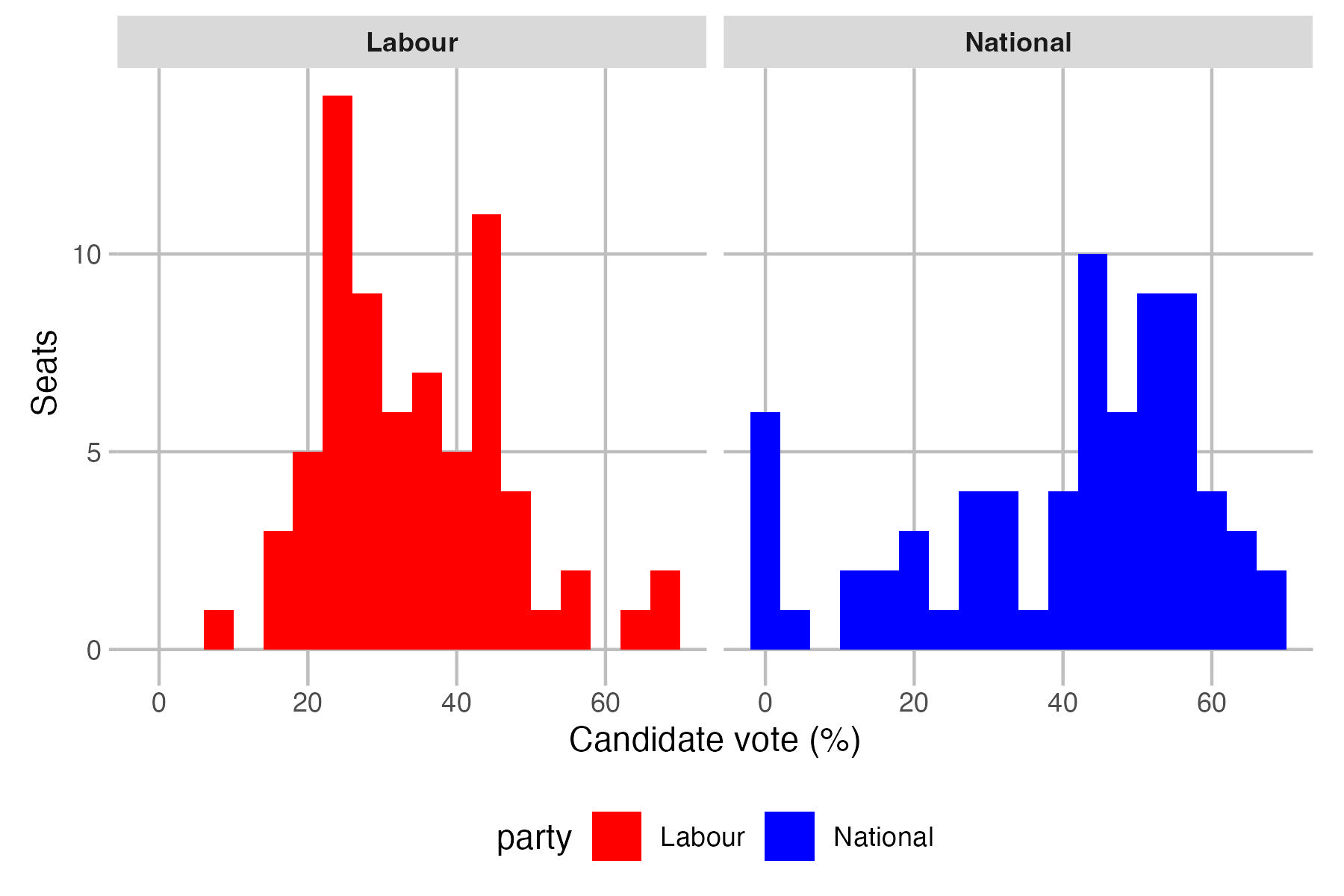
Finally this graph compares the candidate vote for the two major parties. While there are occasional seats involving other parties, the picture is very clear – National tended to achieve a candidate vote in the 40-60% range, while Labour’s was usually under 40%. With such a big difference in how the two parties performed in the electorates, National was bound to win a lot more electorates. And this seems to have mattered.
1:06 – So we will soon have all the data that we will have for some time – the remaining ‘special votes’ won’t be reported until the final results are declared in a few weeks. It is not uncommon for a seat or two to flip in terms of the list vote on those figures, but that’s not the main game now. Opportunity is on 6.0%, which is probably enough to stay above the threshold.
But there are quite a few close electorate races and they could make a big difference. If National or Te Pati Maori lose any seats, it will reduce the overhang. If either of them gain seats, it will widen the overhang.
There are nine seats on margins of less than 5%. These are:
- Wairarapa – National leading Labour by 139 votes
- Wellington Bays – Labour leading Green by 140 votes
- Mt Roskill – Labour leading National by 252 votes
- Hamilton East – National leading Labour by 456 votes
- Te Tai Tokerau – Te Pati Maori leading Green by 492 votes
- Hutt South – Labour leading National by 889 votes
- Whangārei – National leading Labour by 1061 votes
- Nelson – National leading Labour by 1210 votes
It’s worth noting that the special votes have traditionally led to the National Party losing two seats on the party list. Such a change would boost the left count without cutting the actual number of National seats, but it would not be surprising if a similar trend cost the Nationals some of these close races – there are four National seats on that list. It seems likely such a shift would cost the right bloc a majority and put Opportunity in the box seat.
12:37 – Excluding special votes, which won’t be reported for a few weeks, most of the vote has now been counted.
There are still ten overhang seats: I think they are four for Te Pati Maori and six for National, although National is close to having a seven-seat overhang.
This is a pretty severe skewing of proportionality. Right now National have 29.5% of over-threshold votes but 32.3% of seats, while TPM has 0.6% of over-threshold votes but 3.8% of seats.
On a bloc basis it mostly cancels out. ACT and NZF are also under-represented. The collective right is over-represented by 1% while the left is under-represented by 0.4% – the remaining under-representation hits Opportunity.
For what it’s worth, if there were no overhang we’d be currently looking at a parliament of 35 National, 36 Labour, 16 Greens, 13 ACT, 12 NZF, 7 Opportunity and 1 TPM. That would be 60 right, 53 left and 7 for Opportunity. It’s only a couple of seats difference but it would make a big difference.
10:08 – I thought I’d summarise some of the close electorate races:
- Te Tai Tokerau – Aperahama Edwards (TPM) 30.8% leads Hūhana Lyndon (GRN) 28.9% by 444.
- Hutt South – Ginny Anderson (LAB) 45.1% leads Chris Bishop (NAT) 43.4% by 504.
- Mt Roskill – Carlos Cheung (NAT) 45.2% leads Michael Wood (LAB) 44.3% by 194 votes.
- Hamilton East – Ryan Hamilton (NAT) 45.2% leads Georgie Dansey (LAB) 45.0% by 39 votes.
- Takanini – Rima Nakhle (NAT) 47.9% leads Kharag Singh (LAB) 42.7% by 751 votes.
- Wairarapa – Kieran McAnulty (LAB) 44.0% leads Mike Butterick (NAT) 43.0% by 278 votes.
- Wellington Bays – Julie Anne Genter (GRN) 38.1% leads Craig Renney (LAB) 37.0% by 346 votes.
- Whangārei – Lloyd Budd (NAT) 39.8% leads Gary Payinda (LAB) 38.4% by 459 votes.
9:49 – Labour has dropped back to 35 and NZ First is up to 12, putting the current government back into majority.
9:08 – I should also mention Te Tai Tokerau, where the Te Pati Māori candidate has a narrow 255-vote lead. Interestingly the Green Party is in second, Labour third and sitting independent MP Mariameno Kapa-Kingi is in fourth. If Labour or Green take the lead it will not give them any extra seats but will reduce the TPM overhang by one, shrinking the left bloc by one.
9:02 – I think National’s 42nd seat is Hamilton East, where they now lead by 99 votes.
8:59 – National has picked up a 42nd seat, increasing their overhang to 7.
8:58 – Right now National is leading in 41 electorates, although some of those leads are very narrow. Labour leads in 21, Greens in 3, ACT in 1 and Te Pati Māori in 5.
Why is National winning so many electorates on such a small share of the national vote?
Some of the story is undoubtedly voters choosing to vote for a smaller party on the list vote and sticking with Labour or National for their electorate vote – just like how minor parties often do better in the Senate than the House in Australia. Te Pati Māori has been explicitly encouraging voters to just vote for them on the electorate vote. Some people may be doing this tactically but it seems to mostly be sincere.
But there is also the reality that bigger parties get a big winners bonus under a FPTP system and the 71 electorates remain a FPTP system. National also has a more efficient distribution of the vote than Labour, so still pick up a lot of electorates despite a vote trending under 30%.
8:51 – Opportunity remain steady on 5.4%. If they can stay above 5%, I think they’ll will hold the balance of power. But if they fall behind, the right wing government will maintain its majority.
8:49 – The results show the parliament expanding to 130 seats, with the right bloc holding exactly half. National’s list vote is now 0.5% behind Labour so I suspect their fair share of seats has fallen from 36 to 35, with Opportunity increasing to 7, and the National overhang has thus expanded to six seats.
8:46 – In Nelson, National candidate Blair Cameron is just 235 votes ahead of Labour MP Rachel Boyack. Another National seat which is unlikely to hold.
8:43 – In Hutt South, senior National minister Chris Bishop trails his Labour rival Ginny Anderson by 815 votes with 39% counted. It’s very unlikely Bishop will make it in on the list due to the National overhang and right now it’s hard to see him catching up.
8:41 – Cheung’s lead has already shrunk further to 131 votes.
8:39 – As far as I can tell, the narrowest National lead in an electorate right now is Mount Rosehill, where Carlos Cheung leads by 206 votes over his Labour rival with 21% counted. Every seat Labour takes from National reduces the right-wing position by one seat because of the overhang. It’s hard to see National holding this seat.
8:35 – The right-wing lead has narrowed, they now are on 65 seats, the left on 58 and Opportunity on 6. If one more seat flips from right to left it will put Opportunity in the balance of power.
8:33 – On the left, Labour is on 36, Green are on 17 and TPM are on 5. That’s a gain of two each for Labour and Green and a loss of one for TPM.
8:30 – Within the right wing bloc, National is currently on 41 seats, ACT is on 13 and National is on 11, for a total of 65 (down one from my last update).
This would be a loss of 7 seats for National, a gain of two for ACT and three for NZF.
8:24 – Let’s talk overhangs. If a party wins more electorates than it’s share of the national vote justifies in seats, then those extra seats are added to the parliament as a bonus that doesn’t fit with national proportionality.
Right now there would be a lot more potential for electorate leads to change while the number of proportional seats that might change is much smaller, so there’s plenty of room for change. But right now the results sites have Labour and National on pretty much the same list vote but have National winning five more seats – that would be an overhang of 5.
On the other hand, Te Pati Māori is on 0.6% yet are winning five seats – that would be an overhang of 4. So that is two overhangs mostly cancelling each other out.
8:12 – A topic of great interest is whether Opportunity clear the threshold. Without Opportunity, the right has a decent lead on the left. With Opportunity, the right’s lead is quite narrow. Right now, with 24% counted, Opportunity are on 5.4%. If they fall below 5%, they don’t win a single seat.
8:07 – So far results have the right wing bloc winning a majority, but it’s still quite early. With 22% counted, the right wing government is currently on 66 seats, with Labour, Green and Māori on 56, and Opportunity on 7. That’s a narrow right wing majority but also implies a large overhang.
7:00 – It is now 7pm New Zealand time. Polls have just closed in New Zealand.
We should be getting the first results shortly. Advance votes – what we would call ‘pre-poll’ votes in Australia – are counted during the day on election day, and should be reported very shortly. This will result in a large volume of votes being reported very quickly.
Unfortunately I am double-booked, visiting Parramatta’s new Powerhouse museum. I will post a couple of quick updates while I’m out, and then analyse the results in much more depth later this evening.
It is worth noting that in the past there is often a right-wing skew in the early results – in 2023, the TV analysts seemed to be surprised by this, but it shouldn’t be surprising. Despite having the data to do it, it doesn’t seem like booth-matching results happens.
I will be posting updates using New Zealand time, which is two hours ahead of AEDT – 7pm in New Zealand is 5pm in Sydney and Melbourne.